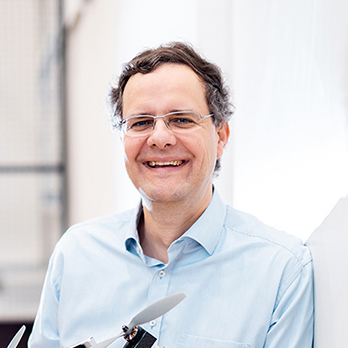
Christian Bettstetter
University of Klagenfurt and Lakeside Labs (Austria)
"Multi-robot systems that sync and swarm: From theory to practice"
How can multiple agents coordinate their timing and movement to produce coherent collective behavior? This talk explores the interplay between synchronization and swarming, following the path from theory to practical applications.
The first part introduces self-organized synchronization and its transfer to wireless systems. The second part covers the theory and practice of swarmalators — a unified approach that interweaves synchronization and swarming to generate a variety of emergent spatiotemporal patterns. Bettstetter shares insights from his group’s work on implementing swarmalators in multi-robot and multi-drone systems. He discusses practical challenges, including limited communication ranges and other constraints, and presents building blocks to realizing swarmalator behavior in real-world technical systems.
Christian Bettstetter is professor of mobile systems at the University of Klagenfurt, Austria, where he heads the Institute of Networked and Embedded Systems. He also serves as scientific director of Lakeside Labs, a research and innovation company. He earned his doctoral degree (summa cum laude) in electrical engineering and information technology from Technische Universität München, Germany. His research group focuses on wireless communications and self-organization in networked systems, with applications spanning telecommunications, robotics, and drones. Bettstetter has received several scientific awards, including best paper awards at IEEE ACSOS and SASO. His dedication to teaching was recently honored with the excellence in teaching award of his university.
Stefano Ferretti
University of Bologna (Italy)
"We Were Told They Were Decentralized"
Blockchain systems are commonly described as decentralized infrastructures designed to remove central authorities and distribute trust among participants. However, decentralization is rarely absolute and, in practice, centralization tends to reappear at multiple layers of the blockchain stack. This talk examines decentralization and discuss how hubs and concentration emerge in these systems. These structures are often driven by rational incentives: efficiency, reliability, liquidity, reduced variance, lower operational costs, and easier coordination. The key point is that hubs are not necessarily a problem by themselves. The risk arises when hubs become indispensable, unaccountable, or correlated through common ownership, infrastructure, or incentives. This requires measuring decentralization, somehow.
Stefano Ferretti is a full professor at the Department of Computer Science and Engineering of the University of Bologna. He is the director of the AnaNSi (Analysis of Networks, Security and Simulation) Research Group. His current research interests include distributed systems, information security, trustworthy AI, complex networks, data science and blockchain technologies.

Sebastian Lobentanzer
Helmholtz Munich (Germany)
"Powerful ≠ Ready: setting the bar for agentic systems"
Raw capability of agentic systems is no longer the main limiting factor for their deployment. Instead, epistemic authority is the bottleneck: establishing correctness of outputs and provenance of decisions. Current development practice of agentic systems is largely ad hoc, driven by informal success criteria and hampered by continuous model upgrades.
We propose to treat evaluation less as an arms race and more as a bar exam: for a well-defined task, experts set a bar that any candidate system must pass. A fixed bar decouples evaluation from model releases and auxiliary technologies such as retrieval-augmented generation, but setting up scalable evaluation in the early stages of development is a challenge of engineering, social, and scientific dimensions. As deciders face growing numbers of seemingly equally valuable options, scaling human evaluation and judgment becomes the most important aspect of agentic applications.
Sebastian Lobentanzer is a principal investigator at Helmholtz Munich and a Helmholtz AI Young Investigator, where he leads research on the governance, evaluation, and open-source infrastructure of agentic AI systems. He also heads Computational Biology at the German Diabetes Research Centre (DZD), is a TUM Junior Fellow at the Technical University of Munich, and serves as a guest principal investigator at Open Targets, EMBL-EBI (Cambridge, UK). He earned his doctoral degree (summa cum laude) in pharmacology from Goethe University Frankfurt.
His research centres on structured frameworks for the design and empirical evaluation of agentic and multi-agent systems, including the Agentic Automation Canvas for prospective governance of AI deployments and work on quantifying the expectation–realisation gap in agentic AI. He created BioCypher, an open-source knowledge graph platform used by over 50 institutions, and BioChatter, a platform for biomedical large language model applications, both published in Nature Biotechnology. He is a member of the European Commission’s Expert Forum on Frontier AI, advises German federal agencies on AI strategy, and leads agentic AI initiatives across the Helmholtz Association and ELIXIR Europe.